The Science of Ferromagnetism

If you've ever tried sticking a fridge magnet to an aluminium can or a gold ring, you already know it doesn't work. Truth is that magnets are incredibly picky. Here is the actual science behind why iron gets an exclusive ability to magnetize while almost every other element gets left out.
Metals and Magnets
It is easy to associate magnets with metals. However, if you bring a fridge magnet close to some metals around you, you may find that not all metals are attracted to it: aluminum, gold, and tin, for example, show no noticeable magnetic pull.
There are only three metals that are strongly attracted to magnets at room temperature: iron, cobalt, and nickel. Iron is the most familiar and common of the three, which is why the phenomenon takes its name from ferrum, the Latin word for iron — even though cobalt and nickel are also ferromagnetic.
Electrons and Magnets
Inside an atom, there exists a nucleus and electrons that move around it. This is the atomic model most of you will be familiar with. To understand ferromagnetic materials, however, we need to look at the atomic model in greater detail.
Electrons in an atom have a property called spin, which can point in one of two directions (referred to as up or down). It is a fundamental rule of physics that any moving charge creates a magnetic field. So, it follows that each spinning electron behaves like a tiny magnet.
In most elements, electrons are found in pairs of one ‘up’ electron and one ‘down’ electron. The direction an electron spins determines the direction of the magnetic field it creates, so two electrons spinning in opposite directions produce magnetic fields that point in opposite directions. As a result, the fields cancel out, which is why most everyday materials are non-magnetic.
Iron and Magnets
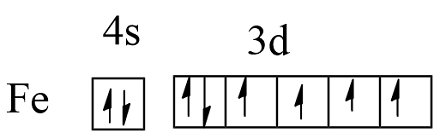
Iron’s magnetic properties are due to its unique electronic structure. In an iron atom, 4 of the atom’s outer electrons are unpaired. This means they all spin in the same direction, with no opposite-spinning electrons to cancel out their magnetic field. This gives iron a strong overall magnetic field.
In chemistry class, you may have come across Hund’s Rule. Electrons prefer to remain unpaired by nature, since electrons carry like charges and pairing them means overcoming this repulsion. This is why, when iron’s 6 outer electrons occupy the 5 orbitals of its 3d subshell, 4 of them are left unpaired.
However, this begs the question: why aren’t more elements ferromagnetic? Iron, cobalt, and nickel are certainly not the only elements with unpaired electrons — even oxygen has unpaired electrons, but it is generally not ferromagnetic (at least at r.t.p). For a material to be ferromagnetic, there is one more condition it needs to meet: perfect atomic spacing in the solid. If the atoms are too close together, the electrons may be forced to pair up, cancelling out their magnetic fields. On the other hand, if they’re too far apart, the electrons point in random directions, which prevents the fields from interacting and reinforcing each other.
Iron, nickel, and cobalt are the only metals that meet both criteria at room temperature. Their atomic spacing sits in an almost ‘Goldilocks zone’ — just right to allow ferromagnetism to occur.
It is interesting to note that a random chunk of iron is not exactly a magnet. However, when an external magnet is brought close to it, the electrons all align in the same direction, giving it a strong field. The same happens when a current is passed through a coil of wire wrapped around the iron: the current generates its own magnetic field, which aligns the iron’s electrons the same way an external magnet would. This is the physics behind electromagnets!
Some Unusual Magnets
Some elements, like gadolinium (Gd) and dysprosium (Dy), can become ferromagnetic when cooled. Both Gd and Dy have stronger atomic magnetic moments than iron. However, thermal energy causes their atoms to vibrate, preventing them from holding a stable magnetic alignment. Cooling these metals removes this excess thermal energy, allowing their magnetic fields to interact and strengthen into a ferromagnetic state. Gadolinium only needs to be cooled slightly below room temperature to become ferromagnetic, while dysprosium needs much deeper cooling, to below about -188°C.
In the end, magnetism isn't some magical force—it's just physics happening at a scale we can't see. Iron is simply perfect: its electrons are spaced exactly right to team up instead of cancelling each other out. It's a tiny microscopic dance that makes our everyday tech work.


Comments