Why Does Heat Make Air Wobbly?

On any hot summer day, you might notice that the air above hot asphalt roads seems to be wiggling. A similar effect can be noticed in the air above a bonfire; looking through to someone on the other side of the fire, you may notice they look wavy or blurry. Why does this happen?
What Is Heat Haze?
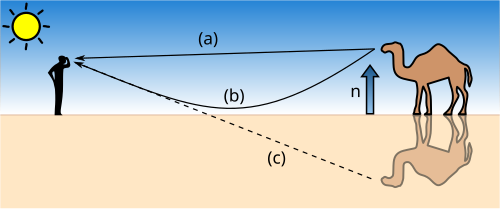
Heat haze, which is the name of this phenomenon, is a consequence of refraction. Heat haze falls under a broader group of refraction-based phenomena called inferior mirages. A mirage is simply an optical illusion caused by the bending of light as it passes through air.
Heat haze can be observed on tarmac roads, around fires, or through any stream of hot air. Let’s consider how heat haze appears on roads. In direct sunlight, asphalt can reach temperatures of 50 to 70 degrees Celsius. The black roads absorb this heat and also emit it, making the air directly above it hotter.
The Role of Refraction
We know that the cooler the air, the denser it is, and vice versa. We also know that when light moves through denser and less dense mediums it appears to ‘bend’, or refract. As the air moves in a convection current, its density is constantly changing; so, the air can be said to have varying refractive indices. When light passes through all these varying indices, it appears to bend by different amounts, giving the viewer the illusion of wobbly air.
More On Inferior Mirages
Inferior mirages are the most common type of mirage you can observe. The term ‘inferior’ refers to the fact that the mirage image appears lower than the real object. Inferior mirages are unstable: they shimmer and shift as the hot air constantly moves, which is part of what makes the effect so striking to watch. The illusion of a puddle of water on the road is also explained using inferior mirages: the continued refraction through layers of hot air near the surface bends light upward toward the viewer, mimicking the look of a reflection.
Superior Mirages
In polar regions, the situation is reversed. Ice and snow cool the air directly above the surface, while the air higher up remains relatively warmer. This temperature inversion produces a different type of mirage called a superior mirage, where objects appear above their true position and can sometimes seem to float above the horizon. Both phenomena are driven by the same underlying physics just in opposite directions.
Where can mirages be observed?
Mirages can be easily observed in areas of extreme temperatures. Deserts are among the best places to witness inferior mirages: the intense heat bakes the sand and air, producing shimmering pools and distant distortions that have famously misled travellers for centuries.


Comments